
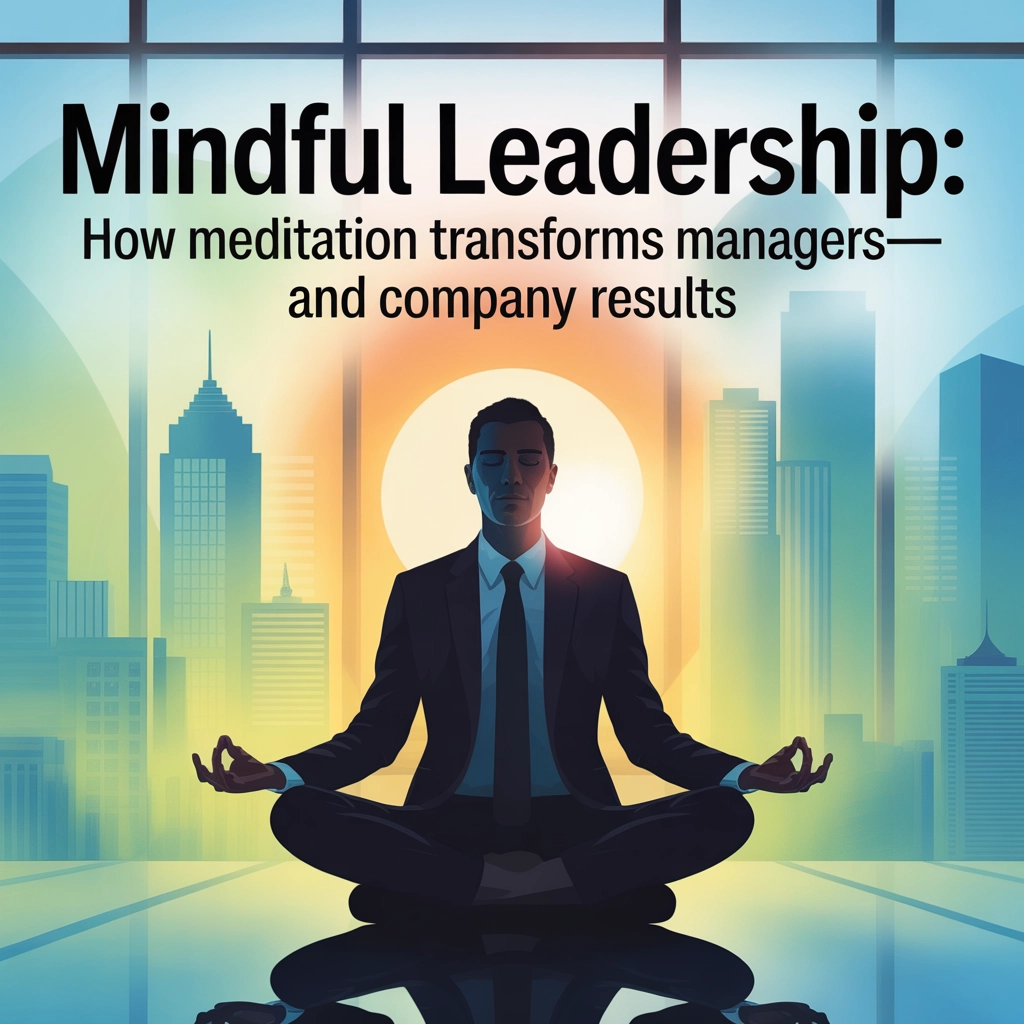
The Bottom-Line Impact of Mindfulness in Business
This blog post is inspired as I reflect on my current work in the well-being field following my many years wearing a suit and tie, although the tie was already going out of fashion as I departed in 2020. What I’ve noticed, though, is that in today’s high-pressure business environment, leadership quality often makes the difference between thriving organisations and struggling ones. What might surprise many executives is that one of the most powerful leadership development tools doesn’t involve spreadsheets or strategy sessions; it’s meditation.
Far from being merely a wellness trend, mindfulness meditation has emerged as a evidence-backed approach to developing more effective leaders and, consequently, more successful businesses. Research from Harvard Business School to Google’s internal studies confirms that when leaders meditate, both their performance and their company’s metrics improve.

The Neuroscience of Mindful Leadership
The leadership benefits of meditation begin with measurable changes in the brain. Regular mindfulness practice has been shown to:
- Reduce activity in the amygdala (the brain’s stress centre)
- Increase grey matter in areas responsible for decision-making
- Strengthen neural pathways related to empathy and emotional intelligence
- Improve function in regions governing attention and focus
A 2022 study published in the Journal of Management Development found that executives who practised meditation for just 10 minutes daily showed a 32% improvement in decision-making quality after eight weeks, particularly during complex or stressful situations.
“The executive brain under chronic stress literally loses access to its most sophisticated cognitive abilities,” explains neuroscientist Dr. Amishi Jha. “Meditation creates the neural conditions for optimal leadership functioning, especially during challenges.”
How Meditation Transforms Leadership Qualities
The research reveals five core leadership competencies significantly enhanced by regular mindfulness practice:
1. Strategic Decision-Making
Leaders who meditate demonstrate improved ability to:
- See the bigger picture beyond immediate concerns
- Consider multiple perspectives before deciding
- Avoid reactive decision-making during crises
- Balance analytical thinking with intuitive insights
Sarah Williams, CFO at Brightline Technologies, credits her twice-daily meditation practice with helping her navigate the company’s complex merger process: “During intense negotiations, I noticed myself responding rather than reacting. This single shift in perspective helped us identify £3.2 million in overlooked synergies that our competitors missed.”
2. Emotional Intelligence
Meditation dramatically improves a leader’s ability to:
- Recognise and regulate their own emotions
- Accurately perceive others’ emotional states
- Respond appropriately to team members’ needs
- Build psychological safety within teams
Research from the University of Westminster found that managers who completed an 8-week mindfulness programme showed a 29% improvement in emotional intelligence scores, with particularly strong gains in empathy and relationship management.

3. Resilience Under Pressure
The data shows mindful leaders demonstrate:
- Reduced burnout rates (47% lower than non-meditating peers)
- Quicker recovery from setbacks and challenges
- Greater stamina during extended high-pressure periods
- More consistent performance regardless of circumstances
When Tesco faced unprecedented supply chain disruptions during 2020, operations director James Harrington implemented a daily team meditation practice. “Not only did our team avoid the burnout affecting our industry, but our fulfilment metrics remained 18% above industry average throughout the crisis,” Harrington reports.
4. Innovation and Adaptability
Mindfulness cultivates cognitive flexibility that directly impacts innovation:
- Enhanced creative problem-solving capabilities
- Greater openness to new approaches and ideas
- Reduced fear of failure that inhibits experimentation
- Improved ability to question established assumptions
A 2023 McKinsey study found that companies with mindfulness programmes for leadership teams launched 31% more successful new initiatives compared to control groups, with higher rates of disruptive innovation specifically.
5. Communication Effectiveness
Leaders who meditate consistently show improvements in:
- Active listening skills
- Clarity of communication
- Presence during conversations
- Ability to navigate difficult discussions
“The most important thing meditation taught me was to truly listen,” explains Richard Branson, who has practised transcendental meditation for decades. “That single skill has been worth billions across my businesses.”
Real-World Business Impact: The Metrics Behind Mindful Leadership
The benefits of mindful leadership extend beyond personal growth—they translate directly to organisational performance across multiple dimensions:
Employee Engagement and Retention
Teams led by managers with regular mindfulness practices show:
- 34% higher engagement scores (Gallup, 2023)
- 28% lower voluntary turnover rates
- 41% fewer sick days taken
- 26% higher likelihood to report finding meaning in their work
The financial impact is substantial: with replacement costs averaging 150% of salary for knowledge workers, reduced turnover alone can save millions.
Profitability and Revenue Growth
The link between mindful leadership and financial performance is increasingly clear:
- Companies with mindfulness training for executives outperformed industry peers by 19% in profit growth over three years (Boston Consulting Group, 2022)
- Sales teams led by mindful managers closed 24% more deals
- Customer retention improved by 17% under leaders with regular meditation practices
- Cost efficiencies increased by 12% through more deliberate decision-making

Innovation Metrics
When leaders meditate, their organisations innovate more effectively:
- 29% more patents filed per R&D pound spent
- 36% faster time-to-market for new products
- 42% higher success rate for new initiatives
- 27% more effective cross-functional collaboration
Unilever attributes over £50 million in new product revenue to innovations developed by teams participating in their leadership mindfulness programme since 2018.
Case Study: Aetna’s Mindful Leadership Transformation
When Mark Bertolini became CEO of health insurance giant Aetna, he brought his personal meditation practice into the company’s leadership development programme. The results were remarkable:
- Productivity gains valued at $3,000 per employee annually
- Healthcare costs reduced by 7% (saving £6.3 million)
- Employee turnover decreased by 28%
- Stock price more than tripled during implementation period
How to Implement Mindful Leadership Practices
For organisations looking to cultivate mindful leadership, research suggests these best practices:
- Start with senior leadership: When executives model and value meditation, adoption throughout management increases by 64%.
- Provide structured training: Formal programmes with qualified instructors show 3.2x better results than self-guided approaches.
- Integrate with existing systems: Companies that incorporate mindfulness into performance reviews and development plans see 76% higher consistent practice rates.
- Measure results: Organisations that track both meditation practice and business outcomes create stronger feedback loops and better ROI.
- Create a supportive culture: Providing dedicated time and space for practice increases participation by 83%.
Many leaders begin with just 10 minutes daily, often using guided meditations focused specifically on leadership qualities. Research shows significant benefits emerge after just 8 weeks of consistent practice.
Conclusion: The Competitive Advantage of Meditation
As business environments grow increasingly complex and demanding, mindful leadership isn’t merely beneficial—it’s becoming a competitive necessity. The evidence is clear: when leaders meditate, decision quality improves, teams perform better, and organisations thrive.
The most compelling aspect of meditation as a leadership development tool is its accessibility. Unlike many business improvements requiring massive investment, mindfulness can be implemented at minimal cost while delivering outsized returns.
For leaders feeling the pressure of today’s business challenges, the research offers a clear directive: the most valuable investment you can make might be time spent in meditation. Your bottom line—and your team—will thank you.
Looking to enhance your leadership and managerial capabilities through mindfulness? Contact me directly to discuss a program for you that can fit in with your goals and requirements.
Recent Comments