
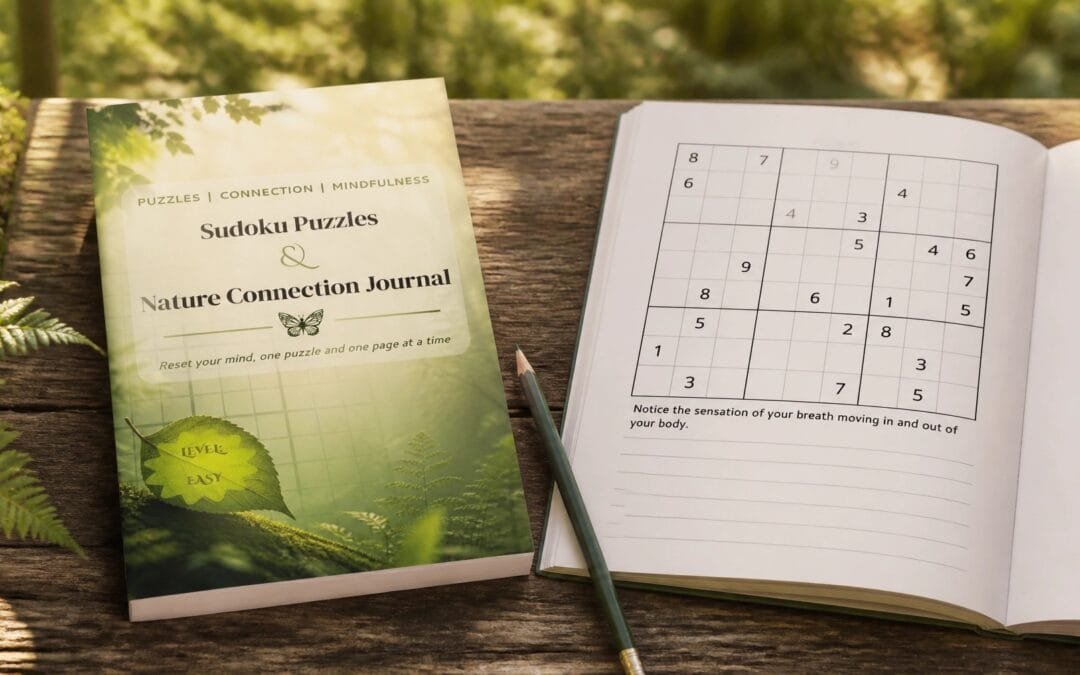
I am delighted to celebrate the launch of my new Sudoku Puzzle and Nature Connection Journal series by TTM Books on Amazon.
This book grew from a simple question: what happens when you combine the concentrated challenge of a Sudoku puzzle with the quiet invitation to notice the natural world?
Not in a grand, complicated way. No special equipment. No app subscription. No need to identify every bird in Worcestershire by its call, although bonus points if you can. Just a pencil, a puzzle, a little space to write, and a willingness to look more closely at what is already around you.
Each edition is comprises 55 Sudoku puzzles, nature-connection prompts, reflection space and complete solutions. The paperback is compact enough to keep beside your chair, in a bag, or somewhere near a window where you can pretend you are about to write, then spend ten minutes watching a robin.
That is the thinking behind this sudoku and nature connection journal: a screen-free activity that gives the analytical mind something satisfying to do, then gently turns your attention outwards.
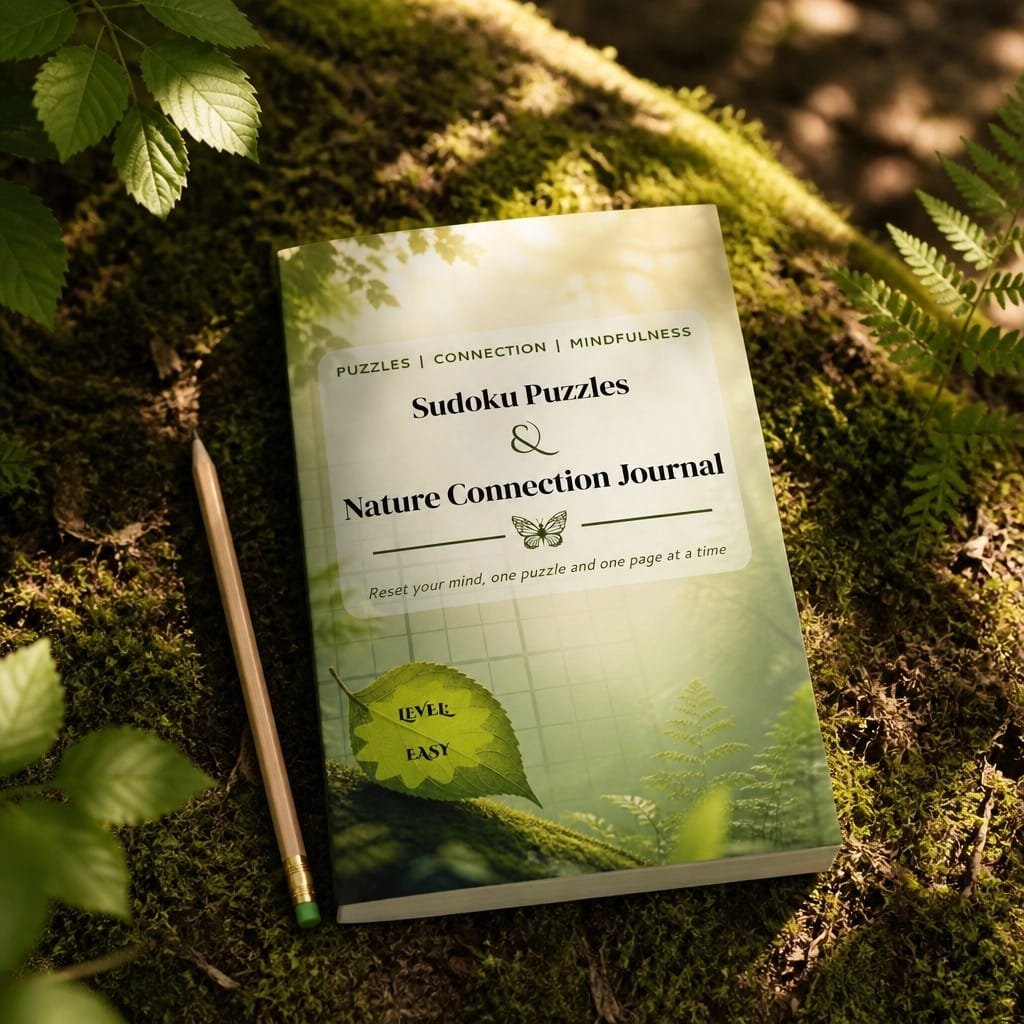
Why a sudoku and nature connection journal works
Sudoku and nature connection may seem like an unlikely pairing at first. One involves numbers, logic and a grid. The other involves trees, weather, birdsong, light and the excellent habit of standing still for a moment.
But the two activities meet in an important place: attention.
When I solve Sudoku, I have to hold several pieces of information in mind at once. I am tracking rows, columns and boxes, remembering possible numbers, checking patterns and noticing when something does not quite fit. This calls on working memory, sustained attention and executive control.
Research into Sudoku and related puzzle-solving tasks suggests that the activity engages frontoparietal brain networks, including areas of the prefrontal cortex involved in planning, decision-making, monitoring and problem-solving. A recent review of Sudoku neuroimaging research discusses these findings in more detail in Frontiers in Neuroimaging.
That does not mean one puzzle will transform your brain into a small, highly efficient supercomputer. I would be suspicious of any book making that promise. The evidence for Sudoku producing broad improvements in intelligence is limited. However, solving a puzzle can provide a useful period of focused mental activity, and many people enjoy the sense of order and progress it creates.
There is also the possibility of flow. This is the absorbing state where a task is challenging enough to hold your attention but manageable enough that you do not immediately want to throw the pencil into a bush. A well-matched Sudoku can create that balance. You become less interested in the clock, your phone and the mental to-do list that has been following you around like an unpaid intern.
Then comes the second part of the book: a nature-based prompt.
After the mental concentration of the puzzle, you might be invited to notice how light falls across a leaf, listen for sounds near and far, or explore the texture of bark beneath your fingertips. These are small observations, but they help shift attention from internal chatter to direct sensory experience.
What forest bathing teaches us about attention
Forest bathing, or Shinrin-yoku, is not simply going for a brisk walk through some trees while not thinking about your emails. It is a slower, more sensory way of being outdoors.
In my own Forest Bathing sessions, I invite people to pause, notice and explore their surroundings without needing to achieve anything. The aim is not to complete a certain distance or reach a particular viewpoint. It is to become more available and open to what is happening around you.
You can read more about the approach I use on my Forest Bathing page, including the sensory activities and evidence-informed nature connection practices behind my sessions.
Research into forest bathing has found reductions in stress markers, including salivary cortisol, alongside improvements in mood and physiological relaxation. A systematic review and meta-analysis available through PubMed found lower cortisol levels in forest groups compared with people in urban environments, although the researchers also noted variation between studies.
Nature is not a magic wand, and one woodland visit cannot solve every difficulty in life. Still, the evidence supporting short-term stress reduction and mood benefits is encouraging. Earlier research, including a widely cited study on the physiological effects of forest environments, is available through the National Library of Medicine.
Nature connection may also support attention restoration. The basic idea is that modern life often asks us to use directed attention constantly. We focus on screens, traffic, deadlines, notifications and conversations. Natural settings can offer softer forms of stimulation, such as moving leaves, changing light and birdsong. These can hold our attention without demanding the same mental effort.
As Stanford Lifestyle Medicine explains, forest bathing differs from ordinary hiking because the focus is not primarily distance, speed or physical achievement. You can explore that distinction in this useful guide to hiking and forest bathing.
From intense focus to gentle noticing
The clever bit, if I may say so, is the transition between the two activities.
Sudoku gives the mind a defined problem. There are rules, boundaries and a visible next step. Nature prompts then offer the opposite kind of attention. They do not ask you to solve the shape of a cloud or calculate the correct number of leaves on a branch. They ask you to notice.
This creates a rhythm:
- Focus on the puzzle.
- Pause when you finish, or when you have had enough.
- Turn your attention towards a sensory detail.
- Write down what you noticed, if you feel like it.
- Allow the experience to be complete without grading it.
That final point is important. You do not have to produce a profound nature observation. “The bark was rough and slightly damp” is perfectly acceptable. So is “I heard a dog, two blackbirds and what may have been a squeaky gate.”
The prompts are inspired by forest bathing, but they are designed to be flexible. You might use them in a garden, on a balcony, beside a canal, in a park or during a quiet moment near a houseplant. If you are physically unable to get outdoors, you can work with a window view or remember a familiar natural place.
This is not about performing mindfulness correctly. It is about giving yourself a moment in which your attention can move from thinking about life to experiencing a small part of it.
Four difficulty levels, one calm idea
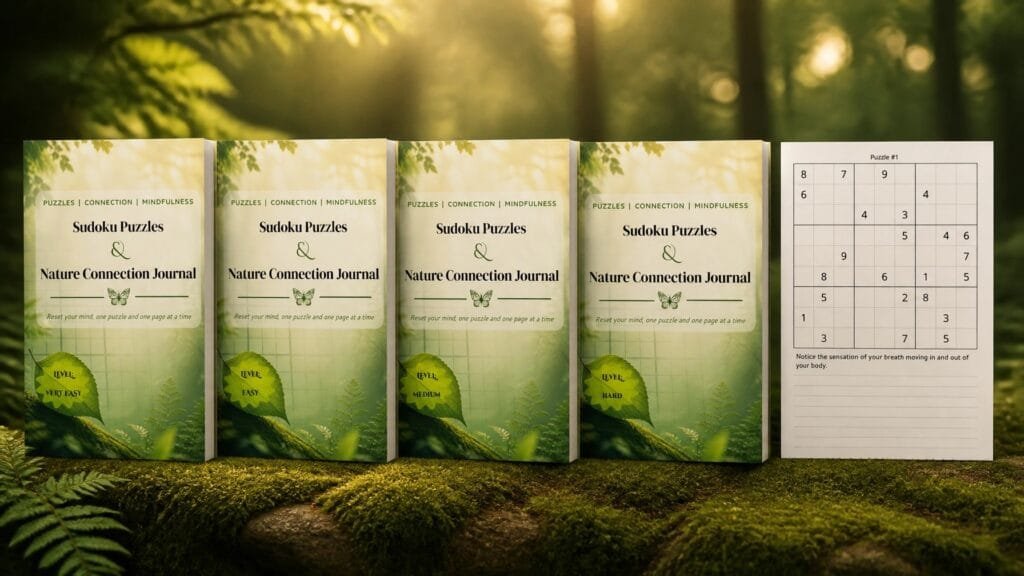
I have created four levels in the series so you can choose the amount of mental challenge that feels right for you:
- Very easy, for beginners, gentle practice or relaxed puzzling.
- Easy, for building confidence while keeping the experience accessible.
- Medium, for a satisfying level of concentration and challenge.
- Hard, for experienced Sudoku solvers who enjoy a more demanding workout.
The right difficulty is not necessarily the hardest one. Sometimes the very easy version is exactly what a tired brain needs. On other days, a hard puzzle can provide the satisfying mental traction that helps everything else fall quiet for a while.
A simple way to use the book
Here is how I would suggest beginning.
Choose a time when you are unlikely to be interrupted. Put your phone somewhere slightly inconvenient, preferably not merely face down beside your hand. I know this trick because I have also been defeated by the tiny glowing rectangle.
Take the book and pencil (and maybe an eraser) outside if you can. Sit somewhere comfortable and spend a minute noticing the general atmosphere. Is the air cool? Is the ground dry? What can you hear?
Then begin the Sudoku. Let the puzzle have your full attention. If you get stuck, take a breath and look again. You do not need to rush. You can use the solutions later, and nobody from the International Sudoku Council is coming round to inspect your technique.
When you finish, read the nature prompt slowly. Follow it in your own way. Notice a patch of light on a leaf. Feel the ridges in bark. Listen for the furthest sound you can detect. Look for movement at the edge of your vision.
Finally, use the reflection space if you wish. You might write one sentence, a few words or nothing at all. The value is in the pause, not in filling every available line.
If you enjoy combining screen-free focus with other calming practices, you may also like my guides to functional breathwork and sound bath meditation sessions. I have found that different practices suit different days. Sometimes I want sound, sometimes breath, sometimes trees, and sometimes a stubborn Sudoku square that refuses to reveal its secrets.
Find the new book series
The new sudoku and nature connection journal series is now launching on Amazon through TTM Books.
and you can visit my TTM Books author page and choose from the very easy, easy, medium and hard editions or even the Gratitude version if that suits you too.
I created these books as a modest invitation to slow down, focus carefully and reconnect with the living world. One puzzle, one observation and one quiet moment at a time.
Recent Comments