In a world where the average person spends over 90% of their life indoors and approximately 11 hours daily looking at screens, we’ve never been more disconnected from the natural world. This disconnection is taking a measurable toll on our physical and mental wellbeing. Yet there’s a remedy that’s both ancient and scientifically validated, accessible yet profound: forest bathing and I feel honoured and privileged to be offering Forest Bathing in Worcestershire.
What is Forest Bathing?
Forest bathing, or “Shinrin-Yoku” as it was first called in Japan during its formal development in the 1980s, isn’t about hiking, exercise, or even literally bathing. Rather, it’s the practice of immersing yourself fully in a forest environment, preferably ancient if you can find one, and engaging all your senses to create a bridge between yourself and the natural world.
Unlike a brisk walk with a fitness tracker or a challenging hike with a destination in mind, forest bathing invites you to slow down, notice the details, and simply be present. It’s a mindfulness practice with trees and Mother Nature as your teachers.
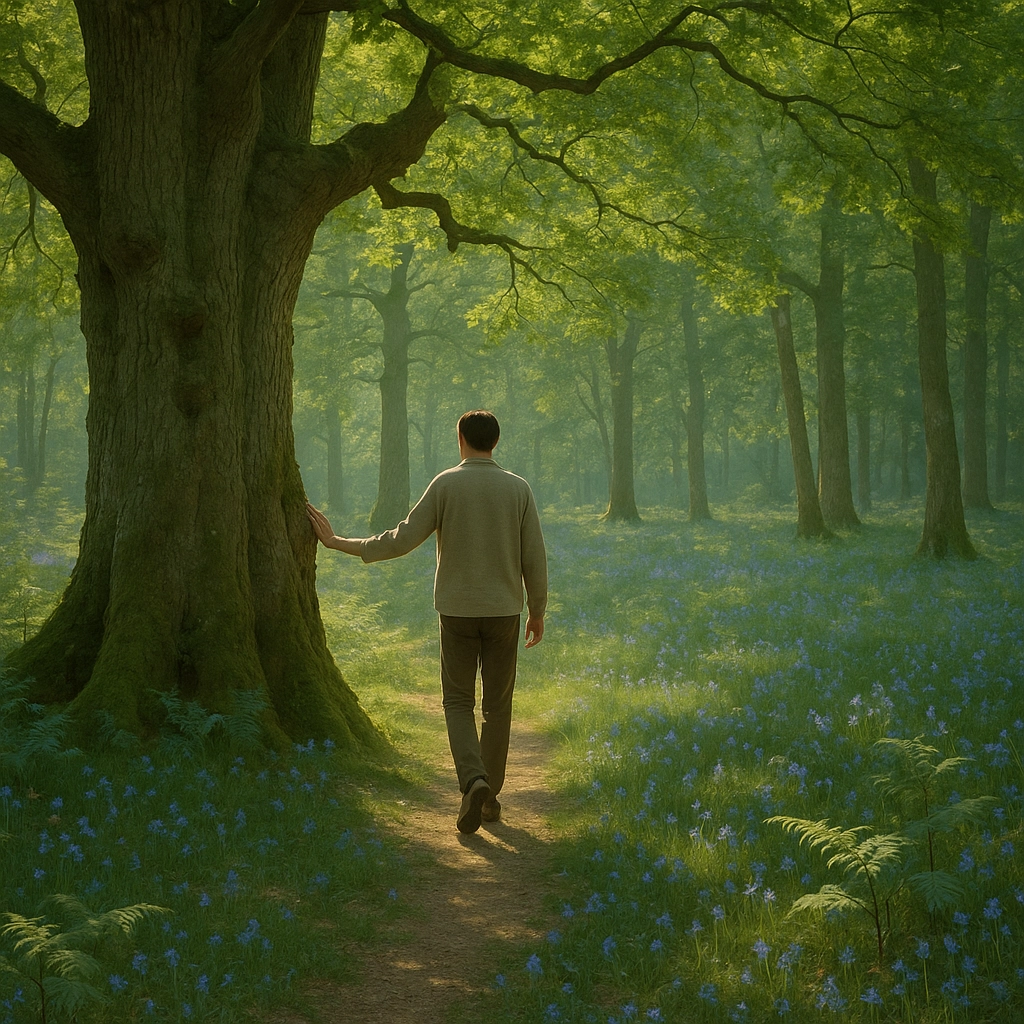
“Most people understand intuitively that being in nature feels good,” explains Dr. Qing Li, Chairman of the Japanese Society for Forest Medicine and world expert on forest bathing. “But what they may not realise is that it’s doing measurable good to our bodies, in ways we’re only beginning to understand.”
The Science Behind Forest Bathing: Why Trees Are Nature’s Therapists
The therapeutic effects of forest bathing aren’t just subjective experiences – they’re measurable physiological responses that researchers have documented in numerous studies. Here’s what happens when you regularly immerse yourself in forest environments:
1. Your Immune System Gets a Significant Boost
One of the most remarkable discoveries about forest bathing is its effect on our immune function. Trees release compounds called phytoncides – essentially their natural antimicrobial defences. When we breathe these in:
- Natural killer (NK) cell activity increases by up to 50%
- The number of NK cells increases
- Anti-cancer protein production rises
- These effects can last up to 7 days after just one 2-3 hour forest visit
Research published in the International Journal of Environmental Research and Public Health confirms these findings across multiple studies, showing consistent immune benefits from regular forest immersion and my colleagues at The Forest Bathing Institute are continuing to develop this research with a UK based lens.
2. Stress Hormones Plummet
Our modern lives keep our stress response systems in a constant state of activation. Forest bathing acts as a reset button:
- Cortisol levels decrease significantly
- Blood pressure drops
- Heart rate variability improves (indicating better nervous system balance)
- Sympathetic nervous system activity (fight-or-flight) decreases
- Parasympathetic nervous system activity (rest-and-digest) increases
“A two-hour forest bath will help you to unplug from technology and slow down. It will bring you into the present moment and de-stress and relax you,” notes Dr. Li in his book ‘Forest Bathing: How Trees Can Help You Find Health and Happiness’.
3. Mental Clarity and Mood Enhancement
Perhaps most noticeably for many participants, forest bathing creates significant improvements in cognitive function and emotional wellbeing:
- Concentration and memory improve
- Symptoms of depression and anxiety decrease
- Rumination (repetitive negative thinking) diminishes
- Creativity and problem-solving abilities increase
- Self-reported mood scores show significant positive changes
These mental benefits stem from something called Attention Restoration Theory, which suggests that natural environments allow our directed attention (which gets fatigued in urban and digital environments) to recover.
Forest Bathing+: Beyond the Basics
At The Tranquil Mind, we’re offering Forest Bathing in Worcester and in particular, using a variation called Forest Bathing+, developed by The Forest Bathing Institute, as an enhanced approach that combines traditional forest bathing with complementary mindfulness practices. This integration creates a more profound and lasting experience. Here’s what makes our approach unique:
Guided Sensory Activation
While traditional forest bathing encourages sensory awareness, our Forest Bathing+ sessions include specific guided exercises that systematically activate each sense, for example:
- Sound mapping: Identifying and locating natural sounds to create a mental “map” of the sonic environment
- Texture dialogues: Using touch to connect with different forest elements
- Forest palettes: Creating visual collections of colours and patterns
- Aromatic journaling: Bringing awareness to the subtle scents of the forest
Integration with Breathwork
The forest is already offering us clean, phytoncide-rich air, but by incorporating specific breathwork techniques, we can amplify the benefits:
- Box breathing in woodland settings to enhance calm
- Extending the exhale while walking to deepen parasympathetic activation
- Using breath as an anchor during moments of distraction
Research from the Royal College of Physicians has shown that combining structured breathing techniques with nature immersion can significantly enhance stress reduction and cognitive benefits.
Mindful Movement Practices
Our Forest Bathing+ approach incorporates gentle movement practices that are specifically designed to deepen your connection with the forest environment:
- Standing meditations with tree support
- Grounding practices and earthing techniques
These movements aren’t about exercise or fitness; they’re about dialogue with the natural world through your body.
How to Experience Forest Bathing: A Simple Guide to Getting Started
You don’t need specialist equipment or extensive training to begin experiencing the benefits of forest bathing. Here’s a simple protocol to try during your next visit to a wooded area:
- Leave technology behind (or at least switch to airplane mode)
- Set an intention to move slowly and notice details
- Use an invitation as your starting point (see examples below)
- Spend at least 20 minutes (though 2 hours is ideal)
- Find a sit spot to settle in one place for at least 15 minutes
- Share your observations with others or in a journal afterwards
Sample Forest Bathing Invitations
These simple prompts can help structure your experience:
- “Notice what is in motion” – spend 10 minutes observing all movement, from leaves to insects
- “Meet a tree” – approach a tree that calls to you and spend time getting to know it through all senses
- “Follow your nose” – let aromatic cues guide your path through the forest
- “Find your sit spot” – allow intuition to guide you to a place that feels right for sitting quietly

The Importance of Regular Practice
While a single forest bathing session offers immediate benefits, research shows that the most significant health improvements come from regular practice. The Japanese medical community recommends at least 120 minutes weekly in forest environments, ideally spread across multiple sessions.
This doesn’t mean you need to find vast swathes of ancient woodland; studies show that even small urban woods, parks with mature trees, and arboretums can provide similar benefits, though older forests with greater biodiversity tend to offer enhanced effects.
Regular practice, even in brief 20-minute sessions, creates cumulative benefits that can significantly improve both physical health markers and psychological wellbeing over time.
Join a Guided Experience
While forest bathing can certainly be practised independently, many people find that their first few experiences benefit tremendously from expert guidance. At The Tranquil Mind, we offer regular Forest Bathing+ sessions in beautiful woodland settings around Worcester.
These guided experiences provide:
- Structured invitations tailored to the specific forest environment
- Safety and orientation for those new to forest settings
- Community connection with like-minded participants
- Context and information about the ecological significance of specific environments
Connecting Forest Bathing to Everyday Life
The ultimate goal of regular forest immersion isn’t just to feel good while you’re among the trees, but to carry that restored state back into your everyday life. Participants in our Forest Bathing+ sessions frequently report lasting effects that transform their approach to daily challenges.
As one regular participant shared: “I find myself calling on forest memories during stressful meetings. I’ll close my eyes for just a moment and recall the sensation of dappled sunlight or the sound of leaves, and I can feel my breathing slow down. It’s like I’ve installed a reset button in my mind.”
This ability to access nature’s benefits even when physically distant from forests represents what researchers call “nature connectedness” – a psychological state associated with improved wellbeing regardless of current environment.
Conclusion: A Prescription for Modern Life
In an era where burnout, chronic stress, and nature disconnection have become normalised, forest bathing offers a compelling alternative – a return to a more balanced relationship with the natural world and, by extension, with ourselves.
As research continues to validate what many cultures have intuitively known for centuries, healthcare professionals are increasingly “prescribing” nature immersion alongside conventional treatments. The simplicity, accessibility, and effectiveness of forest bathing make it an ideal wellness practice for our complex times.
Whether you’re seeking immune support, stress relief, creative inspiration, or simply a deeper connection to the world beyond screens, the forest is waiting – no prescription necessary.
To learn more about forest bathing and other mindfulness practices, explore our blog for additional resources and insights.
Recent Comments