
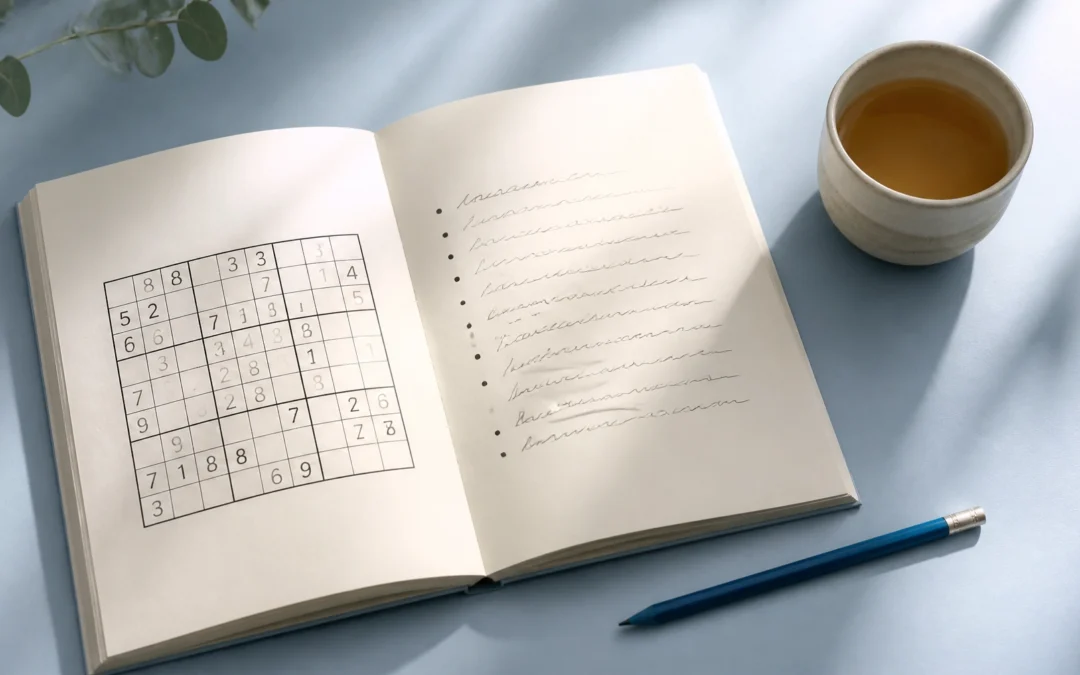
I am delighted to celebrate the launch of my first book from TTM Books on Amazon: the Sudoku Puzzle and Gratitude Journal.
The idea behind this sudoku and gratitude journal is wonderfully simple. Give your mind something clear and manageable to focus on, then give yourself a little space to notice what is already good in your life. The top part of the page asks you to think logically. The next part invites you to think appreciatively.
It is a surprisingly nice pairing.
Sudoku can be absorbing without being noisy. Gratitude can be reflective without requiring a scented candle, a mountain retreat or a particularly convincing pair of linen trousers. Put the two together in a screen-free book and you have a gentle daily ritual for your mind.
Why a sudoku and gratitude journal works so well
There is no direct clinical trial, as far as I can find, testing this exact combination. So I will not pretend that science has already stamped it with a large, official rubber seal.
What we do have is useful research into Sudoku and gratitude separately. The two practices appear to support different parts of a calm, attentive routine.
Sudoku gives the brain a defined problem. Gratitude gives the day a little perspective.
That matters because attention is easily pulled in a dozen directions. A phone buzzes. An email arrives. Someone somewhere has posted an angry opinion about garden fencing. Before long, the mind is busy, but not necessarily productively busy.
A pencil-and-paper puzzle creates a small boundary around your attention. For a few minutes, there is a grid, a set of rules and one empty square that is being rather dramatic about refusing to reveal its secrets.
What Sudoku asks your brain to do
Sudoku is not really a maths puzzle. You do not need to calculate percentages or remember complicated formulas. It is a logic puzzle based on patterns, rules and elimination.
To solve one, you may need to:
- Hold possible numbers in working memory.
- Scan rows, columns and 3 x 3 boxes.
- Notice conflicts and rule out incorrect options.
- Shift between different solving strategies.
- Keep track of what you have already tested.
- Make decisions while tolerating a little uncertainty.
This combination brings several cognitive functions into play, particularly working memory, sustained attention and executive control.
A 2026 systematic review in Frontiers in Neuroimaging examined six brain-imaging studies of Sudoku. Across the studies, Sudoku solving engaged frontoparietal networks, including areas associated with working memory, attention, cognitive control and performance monitoring. The researchers were careful about the limits of the evidence, noting that the number of studies was small and that stronger research is needed before making claims about broad, long-term cognitive improvement.
That is an important distinction. Solving Sudoku clearly uses your thinking muscles. It does not automatically turn you into a human supercomputer who can recall every Wi-Fi password since 2008.
A separate fNIRS study, published in Translational Neuroscience, found increased activity in the prefrontal cortex while participants solved Sudoku. The prefrontal cortex is involved in functions such as attention, working memory, decision-making and problem-solving. The study used a small sample, so it is best viewed as evidence that Sudoku is cognitively engaging, rather than proof of a universal brain upgrade.

Focus, challenge and the possibility of flow
Many people enjoy Sudoku because it offers a clear challenge with immediate feedback. You know when a number fits. You also know, usually within about four seconds, when you have made a spectacularly confident mistake.
This combination of a clear goal, manageable challenge and visible progress can create a flow-like experience. I say “flow-like” deliberately. Direct research measuring flow during Sudoku is still limited, so it would be too strong to claim that every puzzle produces a formal flow state.
However, the conditions are certainly there for deep engagement. When the difficulty feels appropriate, attention can settle. The outside world becomes less demanding for a while. Your mind is not empty, but it is occupied in a contained and purposeful way.
That can feel calming, especially when compared with the vague, scattered concentration created by endless scrolling.
There is also some evidence that puzzles may help reduce anxiety in particular settings. For example, a clinical study involving people receiving haemodialysis found lower anxiety scores among participants who completed Sudoku compared with a control group. That does not mean Sudoku is a treatment for anxiety, or that it will work in the same way for everyone. It does suggest that a structured, absorbing activity may provide a useful mental pause for some people.
What gratitude adds to the picture
Sudoku directs attention towards a problem. Gratitude directs attention towards appreciation.
That does not mean forcing yourself to be cheerful when life is difficult. I have never found “just be grateful” particularly helpful when there is a crisis and the insurance company has placed you on hold for 47 minutes.
Gratitude is more practical than that. It is the habit of noticing something specific that has value, support or meaning. It might be a person, a conversation, a warm meal, a walk, a good night’s sleep or the fact that somebody else made the tea.
The Greater Good Science Center suggests writing about up to five things, with an emphasis on being specific and going deeper rather than creating a hurried list. “I am grateful for my family” is fine. “I am grateful that my sister called when she knew I was having a difficult afternoon” gives the mind more to hold.
Research supports this more grounded approach.
For gratitude on steroids, I often suggest to add in a few words about "why" this particular moment of gratitude matters. It usually helps to have the word "because" as a bridge between the two. I am grateful for <this> because <this>.
A 2023 systematic review and meta-analysis examined 64 randomised clinical trials involving gratitude interventions. The review found improvements in gratitude, mental health and life satisfaction, alongside fewer symptoms of anxiety and depression. The authors also described gratitude as a complementary approach, not a replacement for professional support.
Another study published in the Journal of Happiness Studies found that a brief gratitude-writing intervention helped participants maintain gratitude and reduced stress and negative affect over the following month. The effects were not enormous, and the study had limitations, but this is often how useful wellbeing practices work. They do not need to transform your entire personality before breakfast. A small shift in attention can still matter.
Gratitude has also been associated with better sleep in some studies, although the evidence is mixed and should not be oversold. Writing in the evening may help some people slow down and recognise positive moments from the day, but it is not a guaranteed cure for insomnia.

The calm cognitive focus plus mindful reflection
That combination is what makes a sudoku and gratitude journal interesting to me.
The puzzle section offers structure. It gives the mind a task with edges and rules.
The gratitude section offers reflection. It asks you to pause and recognise what might otherwise disappear into the blur of an ordinary day.
One practice is analytical. The other is emotional and meaning-focused. Together, they create a small screen-free transition from doing to noticing.
I can imagine using the book in several ways:
A morning mental warm-up
Complete a short or easy puzzle with your first cup of tea/coffee. Then write one thing you are looking forward to or one person or thing you appreciate.
An afternoon reset
When work has become a jumble of tabs, notifications and half-finished thoughts, step away from the screen. Spend ten minutes with the puzzle, then add a brief gratitude note.
An evening wind-down
Choose a comfortable difficulty, without turning it into a personal battle against the number seven. After the puzzle, write about one small moment from the day that felt supportive, enjoyable or meaningful.
The key is not perfection. You do not need to complete a page every day. You do not need to write something profound. “The dog looked pleased to see me” is a perfectly respectable gratitude entry.
Four levels, from very easy to hard
I have included four difficulty level options so you can choose the book that meets you where you are.
You might begin with very easy puzzles if Sudoku is new to you, if you want a gentle introduction or if your brain is still negotiating with the morning. The easy level offers a little more challenge without becoming a wrestling match.
The medium level is suitable when you want to concentrate for longer, while hard puzzles are there for experienced solvers who enjoy a proper challenge.
And they all come with the solutions at the back if you get really stuck.
There is no prize for choosing the hardest level immediately. In fact, I think choosing an appropriate level is part of the practice. A puzzle that is too easy may feel dull. One that is too difficult may create frustration rather than focus. The sweet spot is somewhere in between, where you are engaged but still enjoying yourself.
This is also where the gratitude pages can help. They remind you that the value of the session is not measured solely by whether you finish the grid.

A simple way to begin
Try this 15-minute routine three times a week:
- Put your phone somewhere slightly inconvenient.
- Choose a Sudoku difficulty that feels manageable.
- Solve for ten minutes without rushing.
- Notice how your attention feels before and after.
- Write one specific gratitude reflection.
- If you get stuck, pause. Getting stuck is not a character flaw. It is simply part of Sudoku’s small and rather boxy adventure.
If you already practise mindfulness, you may find this routine fits naturally alongside it. My article on the difference between meditation and mindfulness explores how formal practice and everyday awareness can support each other.
For people who find their minds particularly busy in the evening, my guide to Yoga Nidra and sleep offers another gentle, screen-free option. You might also enjoy exploring functional breathwork, especially if you want a practical way to settle your breathing before journalling.
Celebrate the launch with a thoughtful daily ritual
I created this sudoku and gratitude journal because I like the balance between concentration and appreciation. It is practical, uncomplicated and pleasantly old-fashioned. No app subscription. No flashing badges. No algorithm trying to sell you a mattress while you are attempting to place a nine.
If you would like to try my sudoku and gratitude journal, click here to view one option on Amazon. If you would prefer a different degree of difficulty, visit my author page on Amazon and choose the level that suits you.
I hope it gives you a few quiet minutes, a satisfying puzzle and a reason to notice something good.
Further reading and research
- Neural correlates of Sudoku play: a systematic review of brain imaging studies, Frontiers in Neuroimaging, 2026.
- Role of prefrontal cortex during Sudoku task: fNIRS study, Translational Neuroscience, 2020.
- The effects of gratitude interventions: a systematic review and meta-analysis, Einstein, 2023.
- A Brief Gratitude Writing Intervention Decreased Stress and Negative Affect, Journal of Happiness Studies, 2022.
- Gratitude Journal practice guide, Greater Good in Action, University of California, Berkeley.
Recent Comments